

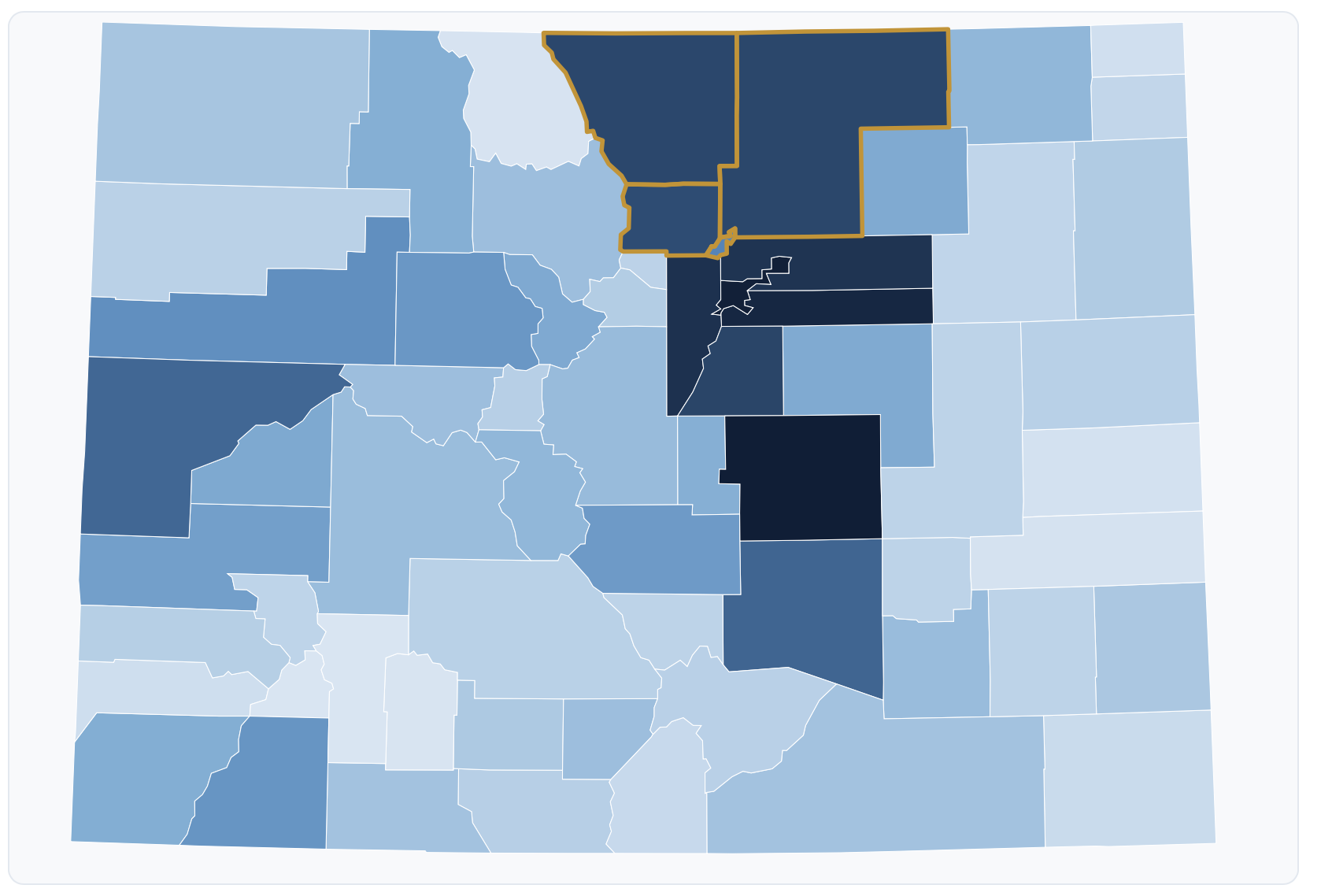
Weld tops Colorado’s large counties in growth
Weld County isn’t just growing — it’s setting the pace.
New U.S. Census Bureau estimates show that Weld ranks as Colorado’s fastest-growing large county, propelling it past Larimer County in population for the first time and reinforcing a regional shift that is redefining the Front Range.
The milestone builds on an earlier turning point: Weld surpassed Boulder County in population soon after the 2020 census, and has continued to widen that lead.
The latest county population estimates, released at 12:01 a.m. Eastern Time Thursday and reflecting data as of July 1, 2025, show Weld posting year-over-year population growth of 1.92%, reaching 378,426 residents — the strongest growth rate among Colorado counties with 50,000 or more residents. That growth pushed Weld past Larimer County, at 377,292 residents, and further ahead of Boulder County, at 328,560. Weld’s growth rate also exceeded that of Douglas County, long one of the state’s fastest-growing, at about 1.6%, and well above Colorado’s overall growth rate of 0.4%.
Year-over-year changes highlight diverging trends in the region. Larimer County grew about 0.82%, while Broomfield County saw a 0.98% increase. Boulder County, in contrast, declined slightly, down about 0.28%. Beyond Northern Colorado, other large counties posted mixed results: Adams County showed continued growth, Jefferson grew slightly, and Arapahoe and Denver declined.
While Weld’s one-year growth exceeded that of other large counties, its growth since the April 1, 2020, census has been even more dramatic, with Weld adding 49,445 residents — a 15% increase — making it No. 1 among large counties. Larimer County grew about 5%, and Broomfield recorded 6.84% growth over the same period. Boulder County has lost population, reflecting higher housing prices and less room to build.
Local economic and business leaders say Weld’s growth reflects both its relative affordability and its geographic reach.
“It’s continuing to be a leader in growth on the Front Range and an ideal destination,” said Rich Werner, president and CEO of Upstate Colorado Economic Development. “There’s a variety of options here — different types of communities, different price points — that allow for a range of housing and lifestyle choices.”
That diversity, Werner said, sustains a broad labor market that extends well beyond county lines. Weld’s workforce spans a roughly 45-mile radius, he said, creating what he described as distinct north and south Weld labor sheds, with the latter stretching into the Denver metro area.
Werner also pointed to a diversifying economy as a key driver. Agriculture and energy dominate the Weld County economy, but growth is also being fueled by industries including life sciences, aerospace, distribution and IT, increasing demand for skilled workers. As a result, companies are relocating Weld or expanding operations there to reach a broader labor pool.
Housing availability also plays a role, said Dennis Schick, managing broker of Re/Max Alliance.
“There’s a lot more new homes available in Weld County. The builders are building in Weld County — and when people build, people come,” Schick said. “There are more opportunities for affordable homes, so we’re seeing migration into those communities.”
Schick said growth is especially strong in Greeley — particularly west Greeley — as well as in Severance, the Weld County portion of Windsor, and southern Weld, including Frederick, Firestone, Dacono and Erie. That southern Weld growth is fueled by spillover from Boulder County and the Denver area, he said.
Nationally, population growth slowed from July 1, 2024, to July 1, 2025, in a majority of the nation’s 3,143 counties and District of Columbia, according to the Census Bureau. That’s attributed in part to lower levels of net international migration, with nine out of 10 counties experiencing drops in that category. Many large counties also are experiencing lower birth rates, as well as net domestic migration loss.
From 2024 to 2025, the fastest-growing counties in the U.S. were:
1, Jasper County, South Carolina, 6%.
2, Waller County, Texas, 5.7%.
3, Kaufman County, Texas, 5.7%.
4, Jackson County, Georgia, 5.3%.
5, Long County, Georgia, 5.2%.
6. Brunswick County, North Carolina, 4.7%.
7. Pinal County, Arizona, 4.6%.
8. Liberty County, Texas, 4.4%.
9. Dawson County, Georgia, 4.2%.
10. Caldwell County, Texas, 4.2%.